 EN

What a Vermiculite Board Actually Does in Service
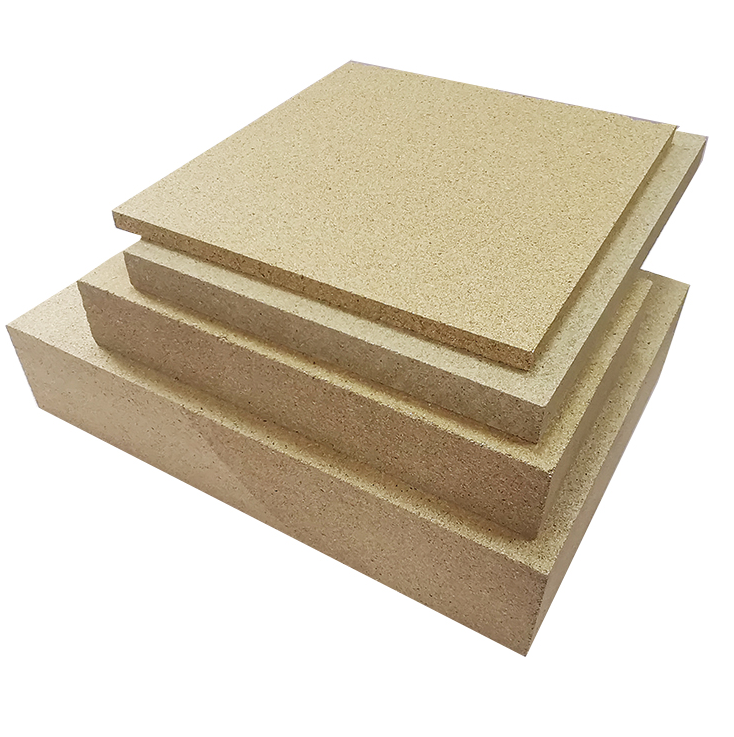
A vermiculite board is a rigid high-temperature insulation panel made from expanded vermiculite, binders, and sometimes reinforcing additives. The mineral is exfoliated, then pressed into sheets with controlled density. It sits between soft ceramic fiber and heavy fire brick: stiffer than blanket, lighter than dense refractory, and unusually tolerant of rapid heating and cooling.
In service, the board rarely acts as simple insulation. Steel ladle covers, aluminum melting cells, fireplace liners, and furnace doors see cycling, vibration, airflow, and occasional splash. The layered structure absorbs thermal shock without cracking like dense brick. Typical densities range from 400 to 1200 kg/m3, with thermal conductivity often around 0.14 to 0.25 W/mK at moderate hot-face temperatures. Many industrial grades are rated to about 1000 C, depending on binder and density.
Grade selection matters. Low-density panels insulate well but crush at anchors. High-density panels take abuse but store more heat. The duty cycle should drive the choice, not a catalog headline.
The Alternatives Most Teams Compare Against
Calcium silicate, ceramic fiber, mineral wool, fire brick, and gypsum board are the usual alternatives. Each has a predictable failure mode.
-
Calcium silicate offers strength and machinability, common in fire doors and backup insulation. Some grades absorb moisture and lose strength after wet-dry cycles, and thermal shock resistance is usually below vermiculite.
-
Ceramic fiber board insulates extremely well with low heat storage. It cuts easily but has low compressive strength, requires fiber controls, and can devitrify after long high-temperature service.
-
Mineral wool board is cheap and available. It works for building fire stopping and lower-temperature industrial use, yet it sags, compresses, or erodes in fast hot gas streams.
-
Fire brick is dense, strong, and chemically robust. It also stores heat, heats slowly, and can spall under fast cycling.
-
Gypsum board is a construction staple for fire-rated walls, not a furnace hot face. Its core breaks down well below industrial process temperatures.
The real question is not which material wins overall. It is which one matches the thermal, mechanical, and chemical load at the lowest installed cost over the expected service interval.
Thermal and Mechanical Performance Side by Side
Typical published ranges appear below. Actual values vary by manufacturer, density, binder, and test temperature. Use the table for screening, then confirm with supplier data.
| Property | Vermiculite board | Calcium silicate | Ceramic fiber board | Mineral wool board | Fire brick |
|---|---|---|---|---|---|
| Density, kg/m3 | 400 to 1200 | 250 to 900 | 200 to 400 | 80 to 200 | 1800 to 2400 |
| Conductivity at 400 C, W/mK | 0.16 to 0.25 | 0.10 to 0.18 | 0.08 to 0.15 | 0.07 to 0.12 | 0.80 to 1.20 |
| Max continuous use, C | 900 to 1100 | 650 to 1000 | 1100 to 1400 | 650 to 750 | 1200 to 1500 |
| Thermal shock resistance | High | Medium | Medium to high | Low to medium | Low |
| Compressive strength | High | Medium to high | Low | Low | High |
| Machinability | Good | Good | Good, dusty | Fair | Poor |
Test methods give those numbers context. Thermal conductivity is often measured under ASTM C177 or ASTM C518. Noncombustibility may follow ASTM E136 or ISO 1182. Surface burning characteristics can be reported under ASTM E84. A lower conductivity number does not automatically win. If anchors, foot traffic, or high-velocity gas are present, a soft fiber board may need protection or a denser grade. A vermiculite board may conduct slightly more heat, but its shape retention can reduce joint gaps and repair frequency.
Where Vermiculite Boards Win and Where They Do Not
Vermiculite boards fit applications with thermal cycling, moderate mechanical load, and accurate dimensions. Furnace doors, ladle covers, aluminum holding furnaces, fireplace inserts, chimney parts, and fire-rated construction details are common examples. The material cuts with standard woodworking tools, holds screws better than soft fiber, and resists cracking during fast heat-up.
Limits exist. It is not the lightest insulator, so weight-critical enclosures may still favor ceramic fiber. It is not a universal chemical barrier. Strong alkalis, certain fluxes, and molten reactive metals can attack the binder or the mineral. High-moisture areas may need sealing because some grades pick up moisture and lose strength. If the hot face exceeds the rated limit, the binder can degrade even when the vermiculite remains stable. Those limits are selection criteria, not defects.
Field Lessons from Retrofits and High-Cycle Equipment
A retrofit at a chemical plant in southern China showed the difference. A large process furnace door had mineral wool board behind a stainless skin. The door cycled several times daily. After about a year, the wool had compressed, the skin had warped, and hot spots appeared near the hinge. The maintenance team replaced it with medium-density vermiculite board, CNC-cut to match the door ribs. Stepped joints and a small expansion gap were used at the frame. After 18 months of similar cycling, thickness loss was minimal and the hot spots were gone. The latch edge still wore from mechanical contact, so a stainless edge strip was added later. That detail mattered as much as the board.
In aluminum melting cells, ceramic fiber can wet and degrade from molten splash. A rigid vermiculite panel often holds up better because it resists wicking. The trade-off is weight and slightly higher heat storage. On a tilting furnace or removable cover, stronger framing may be needed. On a stationary holding furnace, it is usually not an issue.
Published standards and third-party data help separate sales claims from field reality. EN 13501-1 A1 ratings, ASTM E136 noncombustibility results, and accredited lab conductivity curves provide a baseline. They do not replace a trial coupon in the actual atmosphere, but they narrow the field before a full rebuild.
Specifying the Right Board Without Overpaying for Hype
A practical specification starts with six questions:
-
What is the normal hot-face temperature and short-term peak?
-
How many heat cycles occur per day or campaign?
-
Is there abrasion, gas velocity, or molten splash?
-
What atmosphere or chemical contact is expected?
-
What thickness and density hit the thermal target without excess weight?
-
How will the board be cut, anchored, and sealed at joints?
Request batch-specific data for density, compressive strength, thermal conductivity, and noncombustibility. Test cut quality, edge strength, and dust level on a sample. A board that machines well in the shop saves labor on site. Consistent thickness reduces gaps and rework.
For projects that need dependable vermiculite-based insulation and fire protection components, Millegap supports manufacturing, distribution, and user-specific system solutions across steel ladle, aluminum melting, heating equipment, fireplace, furnace, and construction applications. In-house machining, batch traceability, and supply chain coordination help keep specifications consistent from first article to repeat order. The right board is not the cheapest or the densest. It is the one that matches the duty cycle, installs cleanly, and still performs after the hundredth heat cycle.
Table of Contents
- What a Vermiculite Board Actually Does in Service
- The Alternatives Most Teams Compare Against
- Thermal and Mechanical Performance Side by Side
- Where Vermiculite Boards Win and Where They Do Not
- Field Lessons from Retrofits and High-Cycle Equipment
- Specifying the Right Board Without Overpaying for Hype