 EN
EN

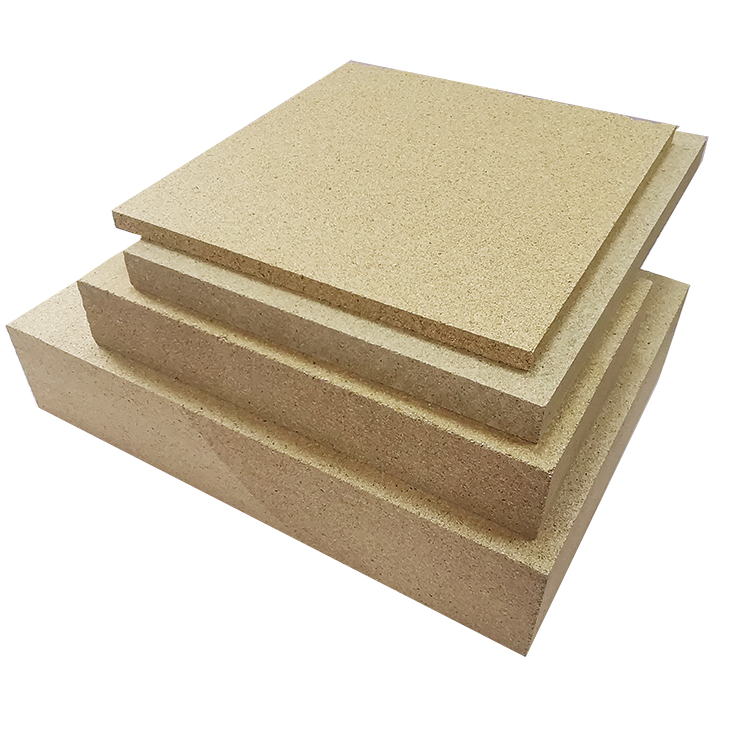
Exceptional Fire Resistance and Passive Fire Protection
Industrial vermiculite board serves as a critical element in passive fire protection strategies, limiting flame spread and maintaining structural compartmentalization without active intervention. Its inherent mineral composition—primarily exfoliated vermiculite, a hydrated magnesium aluminum silicate—makes it uniquely suited for applications where fire integrity is non-negotiable.
Non-Flammability and Expansion-Driven Thermal Barrier Formation
Upon exposure to high temperatures (typically above 1,000 °C), industrial vermiculite board releases chemically bound water in a controlled manner, causing the flakes to expand up to 12 times their original volume. This exfoliation creates a low-density, insulating char layer that fills gaps and restricts heat and hot gas transfer. Unlike combustible materials, the board does not ignite, produce smoke, or contribute fuel load—functioning solely as a passive thermal barrier. The expansion-driven self-sealing effect under thermal stress enhances fire resistance in enclosures and compartment walls, delaying structural heat transfer and safeguarding egress routes and critical equipment until active suppression systems engage.
ASTM E119 & EN 1364 Compliance for Industrial Fire Doors, Ductwork, and Enclosures
Industrial vermiculite board is widely used to meet fire resistance standards including ASTM E119 (fire endurance of building assemblies) and EN 1364 (fire resistance for doors and shutters). In fire door cores, its low thermal conductivity and high-temperature stability support integrity and insulation ratings of up to 120 minutes, depending on thickness and configuration. For ductwork and ventilation enclosures, it helps maintain fire-resistance integrity across air-handling systems, preventing inter-compartment fire spread. Testing confirms the board withstands standard time-temperature curves while limiting unexposed surface temperature rise to below 140 °C—achieving compliance without intumescent coatings, relying entirely on its refractory properties. Its lightweight nature also enables thinner, more efficient fire barrier assemblies that still satisfy rigorous industrial safety requirements.
High-Performance Thermal Insulation for Demanding Industrial Environments
Low Thermal Conductivity (0.05–0.12 W/m·K) in Furnaces, Kilns, and Aluminum Melting Cells
Industrial vermiculite board’s thermal conductivity ranges from 0.05 to 0.12 W/m·K—an exceptionally low value driven by its exfoliated microstructure, which traps countless stationary air pockets that impede conductive and convective heat flow. In furnaces and kilns operating above 1,000°C, this property minimizes heat loss through linings, enabling stable process temperatures with reduced fuel input. In aluminum melting cells, consistent insulation prevents temperature drops that increase melt viscosity and promote dross formation. Real-world deployments have shown energy consumption reductions of up to 25% (Industry Energy Audit, 2023), lowering operational costs and extending refractory service life by mitigating thermal cycling stress.
Optimizing Density (200–400 kg/m³) for Heat Retention, Structural Integrity, and Handling
Selecting the optimal density balances thermal performance, mechanical strength, and practical handling. At 200 kg/m³, the board achieves minimum thermal conductivity (0.05–0.07 W/m·K) due to high porosity—but offers low compressive strength and requires careful, hand-only cutting. At 400 kg/m³, conductivity rises to 0.10–0.12 W/m·K, yet compressive strength increases significantly, supporting robust CNC machining and field installation. The table below outlines key trade-offs:
| Density (kg/m³) | Thermal Conductivity (W/m·K) | Compressive Strength | Handling Suitability |
|---|---|---|---|
| 200 | 0.05–0.07 | Low | Delicate, hand-cut only |
| 300 | 0.08–0.10 | Moderate | Suitable for CNC, good for liners |
| 400 | 0.10–0.12 | High | Ideal for heavy-duty custom barriers |
For aluminum melting cells—subject to intense thermal cycling and mechanical loads—a density of 300–350 kg/m³ is typically selected. This range delivers acceptable insulation, strong thermal shock resistance, and precision machinability for tight-fitting, long-life liners.
Practical Installation and Fabrication Advantages of Industrial Vermiculite Board
Lightweight, CNC-Machinable, and Field-Cuttable for Custom Fire Barriers and Liners
With a density of just 200–400 kg/m³, industrial vermiculite board is significantly lighter than traditional firebrick or calcium silicate boards—reducing structural loading, transportation emissions, and labor-intensive handling. Its mineral matrix responds predictably to standard CNC tooling, allowing precise fabrication of complex geometries: bevels, cutouts, and custom-fit panels for fire doors, duct wraps, and furnace liners. On-site, it can be cut using common woodworking tools—no specialized training or equipment required. This adaptability eliminates reliance on prefabricated metal enclosures and supports just-in-time installation during maintenance windows. The result is faster deployment, reduced worksite congestion, and cost-effective retrofit solutions—even in confined industrial spaces—without compromising fire or thermal performance.
Proven Real-World Applications Across Heavy Industry
Case Study: Energy-Efficient Lining in a Tier-1 Aluminum Smelter’s Melting Cell (30% Reduction)
A tier-1 aluminum smelter replaced aging insulating firebrick with high-density (350 kg/m³) industrial vermiculite board in a primary melting cell. The previous lining suffered repeated thermal shock damage and spalling, triggering unplanned downtime. The new vermiculite board—rated for continuous use at 1,100°C—delivered a 30% reduction in energy consumption for temperature maintenance (Industry Energy Audit, 2023), thanks to its low thermal conductivity (0.08 W/m·K) and superior thermal shock resistance. Over 18 months of continuous operation, no deformation, cracking, or spalling occurred. Improved temperature uniformity reduced dross formation and increased metal yield. Lightweight, CNC-machined panels enabled full installation during a single scheduled maintenance shutdown—validating the material’s real-world fabrication advantages and operational impact in heavy industry.